Pattern Recognition in Watches: Collector Insights & Market Analysis | Dapper Work
✨ This article was AI edited. Editorial responsibility: DapperWork.
Pattern recognition in watches refers to the analytical methodology employed by seasoned horologists, appraisers, and collectors to identify minute typographical nuances, dial texture variations, bezel font serif changes, and market cycle behaviors that distinguish rare references from standard production timepieces.
In the upper echelons of vintage and modern watch collecting, value is determined in millimeters and serifs. Two timepieces manufactured within months of each other on the same assembly line can command wildly divergent valuations based entirely on microscopic dial variations, font weights, or case stamping characteristics. Cultivating sharp pattern recognition is the single most valuable skill an aspiring or veteran collector can develop to navigate the nuances of the global horology market.
Contents
- The Foundations of Horological Pattern Recognition
- Micro-Typographical Analysis: Spotting Dial Variations
- Authentication Protocol: Identifying Redials and Service Replacements
- Macro Case Geometry: Preserving Factory Chamfers and Edge Definition
- Macro Market Cycles: Recognizing Price Patterns
- Frequently Asked Questions
The Foundations of Horological Pattern Recognition
Horological pattern recognition operates across three distinct domains of analysis:
- Typographical & Dial Serifs: Analyzing font kerning, serif geometry, flat-four bezels, open vs. closed sixes and nines, and step dial depths.
- Material Aging & Patina Dynamics: Differentiating between authentic, chemically undisturbed tritium or radium degradation versus artificially aged luminous material.
- Case Geometry & Chamfers: Evaluating factory-original lug bevels and brushed textures versus aggressive mechanical over-polishing.
- Market Volume & Price Action Cycles: Recognizing supply contraction patterns, auction room bidding momentum, and secondary market liquidity shifts before broad price inflection points.
Micro-Typographical Analysis: Spotting Dial Variations
Manufacturers in the mid-to-late 20th century frequently utilized multiple third-party dial suppliers (such as Singer, Beyeler, and Stern). Each supplier produced distinct printing plates resulting in subtle variations that collectors categorize into historical Marks:
| Pattern Feature | Visual Indicator | Horological Significance |
|---|---|---|
| Flat Four Bezel | Trapezoidal inner apex on the numeral ‘4’ of the bezel | Signifies early anniversary production runs (e.g. Rolex 16610LV Kermit) |
| Radial / Step Dials | Recessed subdial tracks and perimeter step drop-offs | Pre-1970s dial stamping techniques denoting original factory authenticity |
| Long E / Small Crown | Central horizontal bar of the letter ‘E’ extending equal to top and bottom bars | Rare typography batches commanding significant collector premiums |
| Gilt Gloss vs. Matte Dials | Negative printing process exposing brass base plate under lacquer | Golden age production indicating high rarity and historical significance |
Authentication Protocol: Identifying Redials and Service Replacements
One of the most critical applications of pattern recognition is detecting non-original dial restorations and factory service replacement parts. A disciplined appraiser follows a systematic inspection checklist:
1. Minute Track Alignment
Inspect the peripheral hash marks using a 10x or 20x loupe. Factory printing displays razor-sharp perpendicular lines that precisely align with applied hour markers. Amateur redials frequently exhibit micro-smudging, uneven line thicknesses, or slight angular drift.
2. Luminous Plot Uniformity
Evaluate the consistency of tritium or modern Super-LumiNova application. Genuine factory plots exhibit organic surface micro-texturing, whereas aftermarket relumed dials show rounded, bulbous edges or inconsistent UV fluorescence decay rates.
3. Handstack and Pinion Geometry
On complex multi-hand chronographs and GMT timepieces, verify that the order of hand stacking matches reference specifications precisely, with clean canon pinions showing zero burrs or tool slip markings.
Macro Case Geometry: Preserving Factory Chamfers and Edge Definition
While dial analysis commands enormous attention, case finishing provides undeniable physical proof of a timepiece’s operational history. An unpolished case retains razor-sharp transitions between mirror-polished lug bevels (chamfers) and satin-brushed top surfaces. Over-polishing rounds off crisp lug contours, thins crown guards, and distorts the factory silhouette, drastically diminishing historical collectibility.
Macro Market Cycles: Recognizing Price Patterns
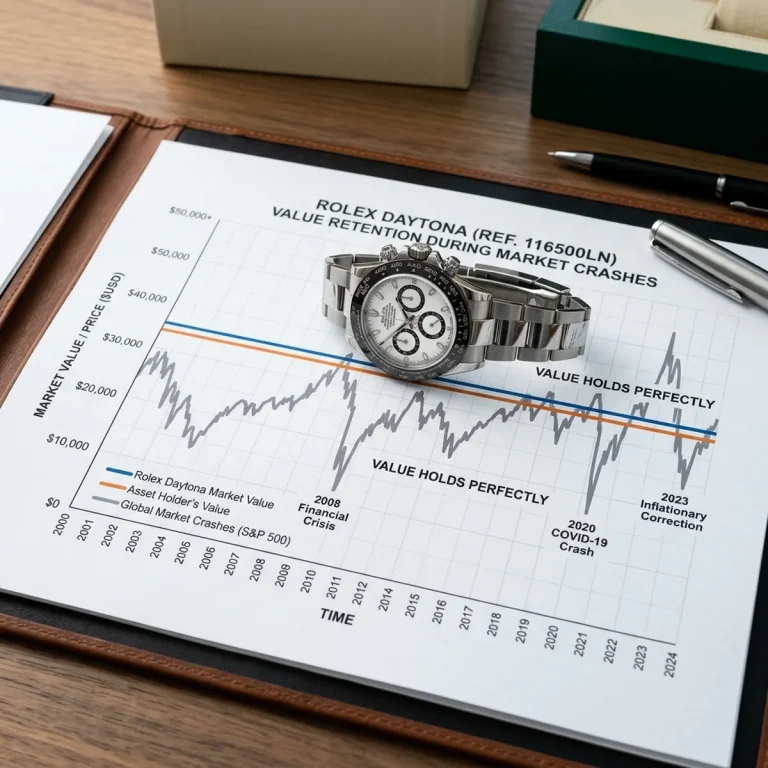
Beyond individual physical watches, pattern recognition extends to the financial mechanics of the secondary watch market. Collectible timepieces follow predictable multi-year liquidity waves driven by macroeconomic liquidity, reference discontinuation announcements, and milestone brand anniversaries.
Astute collectors monitor inventory turnover velocity across major grey market platforms and auction catalogs, recognizing when a reference begins drying up from open circulation before public pricing adjustments take place.
Frequently Asked Questions
What is the most effective tool for practicing horological pattern recognition?
A high-quality 10x achromatic triplet loupe combined with standardized macroeconomic reference literature and high-resolution macroscopic auction archives provides the foundation for dial verification.
Why do small typographical variations impact watch values significantly?
Micro-variations indicate specific production batches, prototype runs, or transitional references produced in limited quantities, creating extreme scarcity that drives intense collector demand.
How can a collector distinguish genuine tritium patina from artificial aging?
Genuine tritium patinas show consistent tonal aging across hands and indices under UV excitation, accompanied by specific decay curves without the powdery chemical residues left by artificial staining dyes.
What is a transitional reference in watch collecting?
A transitional reference is a watch model produced during the shift between two eras, often combining vintage aesthetic attributes (such as acrylic crystals) with modern mechanical calibers (such as high-beat hacking movements).
Get our latest guides, news, and insights highlighted in your Google Search & AI Overviews.