
Rolex Day-Date Variations: Complete Guide to Metals, Dials & References
✨ This article was AI edited. Editorial responsibility: DapperWork.
The Rolex Day-Date, universally revered as the “Rolex President,” stands as the quintessential pinnacle of prestigious horology. Launched in 1956, it was the first waterproof, self-winding chronometer wristwatch to display both the date and the day of the week spelled out in full. Over nearly seven decades of production, the myriad of Rolex Day-Date variations—spanning precious metals, case sizes, bespoke dials, gem-set bezels, and mechanical movements—has created one of the richest and most collectible landscapes in luxury watchmaking.
Contents
- The Heritage of the “President”: A Brief History
- Case Size Variations: From Vintage 36mm to Modern 40mm
- Precious Metal Variations and Signatures
- Exotic, Stone & Historical Dial Variations
- Movement Generations: From Single Quickset to Calibre 3255
- Investment and Value Retention Among Day-Date References
- Frequently Asked Questions (FAQ)
The Heritage of the “President”: A Brief History
Debuting in 1956 with references 6511 and 6611, the Day-Date introduced a revolutionary calendar mechanism that instantly updated both the day and date at midnight. What truly cemented its legendary status, however, was Rolex’s strict metallurgical rule: the Day-Date is forged exclusively in solid precious metals—18k Yellow Gold, 18k White Gold, 18k Everose Gold, or 950 Platinum. Stainless steel or two-tone (Rolesor) options have never officially existed in the core collection.
When President Dwight D. Eisenhower, Lyndon B. Johnson, and numerous global leaders and titans of industry adopted the watch on its distinctive three-piece semicircular link bracelet, the bracelet—and subsequently the watch itself—became known globally as the “President.”
Case Size Variations: From Vintage 36mm to Modern 40mm
Understanding the dimensional evolution of the Day-Date is essential when choosing between vintage charm and modern wrist presence:
1. Classic Day-Date 36mm (The Heritage Standard)
The 36mm diameter represents the timeless proportion of the Day-Date, maintained continuously from 1956 to today’s reference 128238 / 128239 / 128235. It offers universal versatility, fitting under tailored shirt cuffs while retaining formidable wrist presence due to its substantial gold weight.
2. Day-Date II (41mm – Produced 2008–2015)
In response to early 2000s oversized watch trends, Rolex introduced the 41mm Day-Date II (references like 218238 and 218239). Featuring a wider bezel, thicker lugs, and a muscular case profile, it remains a bold, collectible chapter in the model’s history.
3. Day-Date 40 (40mm – Introduced in 2015 to Present)
In 2015, Rolex refined the larger Day-Date with the 40mm reference 228238, 228239, 228235, and 228236. Offering more harmonious proportions than the Day-Date II, slimmed-down lugs, ceramic inserts inside the bracelet links to prevent stretch, and the cutting-edge Calibre 3255 movement, the Day-Date 40 is widely considered the ultimate modern luxury reference.
Precious Metal Variations and Signatures
| Metal Type | Rolex Alloy Details | Key Characteristic & Signature Dial |
|---|---|---|
| 18k Yellow Gold | Proprietary 750‰ pure gold cast in Rolex’s own foundry | The classic archetype; paired with Champagne, Black, Green, or Onyx dials |
| 18k White Gold | High-purity white gold alloy that never fades or yellows | Understated stealth wealth; silver, blue, olive green, or meteorite dials |
| 18k Everose Gold | Patented rose gold alloy enriched with platinum to resist discoloration | Warm, contemporary luxury; signature Sundust, Chocolate, or Eisenkiesel stone dials |
| 950 Platinum | 950‰ pure platinum alloy with tremendous heft and density | The apex of Rolex luxury; distinguished exclusively by the iconic Ice Blue dial |
Exotic, Stone & Historical Dial Variations
The true connoisseur’s playground lies in Rolex Day-Date dial variations. Over decades, Rolex has produced some of the most extraordinary artisanal dials in watch history:
- Hardstone Mineral Dials: Highly prized by vintage collectors, Rolex created dials sliced directly from natural minerals. Notable examples include Onyx (deep piano black without markers), Lapis Lazuli (vivid royal blue with gold flecks), Malachite (striated emerald green), Eisenkiesel (dark quartz with orange iron ribbons), Turquoise, and Bloodstone.
- Stella Lacquer Dials: In the 1970s and 1980s, Rolex offered vibrant, multi-layered glossy enamel-like lacquered dials in saturated tones: coral pink, turquoise blue, oxblood red, canary yellow, and kelly green. Once slow sellers, vintage Stella Day-Dates now command six-figure auction results.
- Meteorite Dials: Crafted from thin slices of the prehistoric Gibeon meteorite, featuring natural crystalline Widmanstätten patterns ensuring no two dials are identical.
- Gem-Set and Pavé Dials: Ranging from subtle baguette-cut diamond hour indices at 6 and 9 o’clock to full diamond-pavé dials and rainbow sapphire bezels.
Movement Generations: From Single Quickset to Calibre 3255
- Calibre 1055 & 1556 (Non-Quickset): Found in vintage references (6611, 1803). Changing the day and date required manually turning the hands through full 24-hour cycles.
- Calibre 3055 (Single Quickset – Introduced 1977): Found in reference 18038 / 18039. Allowed instant rapid-setting of the numeric date via crown position 2, while the day still required rotating the hands.
- Calibre 3155 (Double Quickset – Introduced 1988): Found in references 18238, 118238. Enabled independent, rapid quicksetting of both the day of the week (counter-clockwise) and numeric date (clockwise) from the crown.
- Calibre 3255 (Modern Superlative Chronometer): Powering modern references 128238 and 228238. Features Rolex‘s patented Chronergy escapement, Paraflex shock absorbers, blue Parachrom hairspring, -2/+2 seconds daily accuracy, and an expanded 70-hour power reserve.
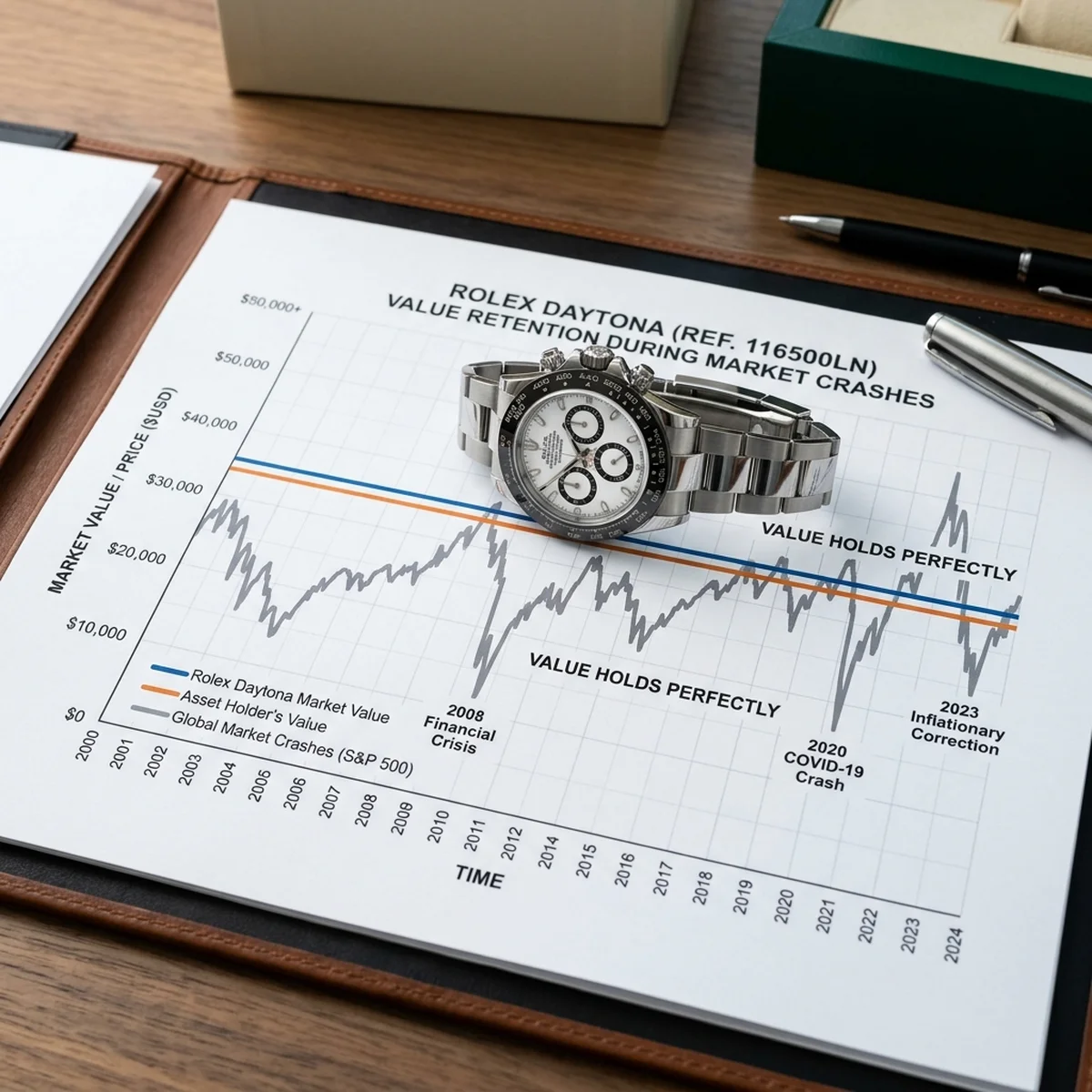
Investment and Value Retention Among Day-Date References
While modern Rolex sports models (Submariner, Daytona, GMT-Master II) dominate retail waiting lists, precious metal Day-Dates represent enduring, intrinsic wealth. Key factors driving secondary market premiums include:
- Original Stone & Stella Dials: Rare natural stone dials (Onyx, Turquoise, Lapis) on references 18038 / 18238 command 50% to 150% premiums over standard champagne dials.
- Platinum Models (Ice Blue): Platinum references 118206, 218206, and 228236 experience the lowest depreciation due to limited production numbers and the sheer prestige of the material.
- Bracelet Integrity: On vintage Day-Dates, tight President bracelets with minimal pin wear and stretch preserve substantial collector value.
Frequently Asked Questions (FAQ)
Has Rolex ever produced a stainless steel Day-Date?
No. Standard production Rolex Day-Date models have always been produced strictly in 18k gold (Yellow, White, Everose) or 950 Platinum. Very few experimental stainless steel prototypes were made in the late 1950s for watchmaker testing, but none were ever made available for commercial retail.
How many languages does the Rolex Day-Date support?
Rolex produces Day-Date day discs in 26 different global languages, including English, Spanish, French, German, Italian, Arabic, Japanese, Russian, Chinese, Latin, and Hebrew.
What is the difference between a fluted bezel and a smooth bezel on a Day-Date?
Fluted bezels are standard on 18k Yellow, White, and Everose gold models, engineered with sharp triangular facets that catch the light. Smooth bezels were historically reserved exclusively for Platinum Day-Dates, though in 2022 Rolex engineered the first fluted bezel in 950 Platinum.
Get our latest guides, news, and insights highlighted in your Google Search & AI Overviews.


