
Where Is the Serial Number on a Rolex Datejust: Location Guide
If you’ve ever wondered how to authenticate or date your Rolex Datejust, locating its serial number is a key step. This unique identifier, frequently enough tucked away in less obvious places, helps verify authenticity, track production year, and even affects resale value. For collectors and enthusiasts alike, knowing exactly where to find the serial number on your Datejust is essential-not just for verification, but for appreciating the watch’s history and craftsmanship.
Rolex has evolved the placement of serial numbers over time. Older Datejust models,typically made before 2005,have the serial engraved between the lugs at the 6 o’clock position-requiring careful removal of the bracelet to see. Modern versions, though, feature the serial number etched on the inner bezel or ”rehaut,” visible only when you tilt the watch face just right. This shift helps combat counterfeiting, making it trickier but more rewarding to find and confirm your watch’s identity. In this guide,we’ll walk you through exactly where to look on your Rolex Datejust,making the process straightforward and empowering-whether you’re a seasoned collector or a first-time buyer eager to understand the mechanical marvel on your wrist.
Contents
- Understanding the Role of Serial Numbers on Rolex Datejust Watches
- Exact Locations to Find Your Rolex Datejust Serial Number
- how to Identify Serial Numbers on Different Datejust Models
- Reading and Decoding Your Rolex Datejust Serial Number
- Serial Number Placement Differences by Production Year
- Tools and Tips for Safely Viewing Your Serial Number
- Why Knowing Your Rolex Datejust Serial Number Matters
- authenticity and Serial Numbers: Avoiding Rolex Fakes
- Using Your Serial number to track Service History and Value
- Common Serial Number Questions from Rolex Collectors
- Frequently Asked Questions
- Q: How can I find the Rolex Datejust serial number without removing the bracelet?
- Q: Why does the serial number location differ between older and newer Rolex Datejust models?
- Q: What tools are recommended to safely view the Rolex Datejust serial number?
- Q: Can scratched or worn serial numbers on a Rolex Datejust still confirm authenticity?
- Q: How does the serial number on a Rolex Datejust help in tracking its service history?
- Q: Are there differences in serial number engraving visibility on steel vs. precious metal Rolex Datejust models?
- Q: What steps can I take if I cannot locate the serial number on my Rolex Datejust?
- Q: How can knowing the serial number location improve my Rolex Datejust buying experience?
- To Conclude
Understanding the Role of Serial Numbers on Rolex Datejust Watches
Rolex serial numbers are far more than just a string of characters etched into the metal; they are the DNA of your Datejust watch, offering a unique identifier that connects your timepiece to its origins. Each serial number is a precise code that reveals when and where your Datejust was produced, making it an essential tool for collectors, enthusiasts, and everyday owners alike. Beyond simple identification, the serial number carries stories of craftsmanship, authenticity, and sometimes, provenance-it can verify a watch’s legitimacy or provide clues about its journey through decades of horological history.
Understanding these numbers means appreciating the importance Rolex places on meticulous record-keeping and quality control. Rolex doesn’t just rely on visual beauty or a robust in-house movement (like their reliable automatic calibers); they back it up with detailed tracking, using serial numbers to differentiate each watch from millions produced. For example, Datejust models dating back to the 1950s have serial numbers that can pinpoint the approximate production year, which can significantly impact the watch’s collectibility and value. This is crucial when navigating the vintage market, where knowing a watch’s production date can help avoid fakes or mismatched parts often found on counterfeit pieces.
Moreover, a Rolex Datejust’s serial number isn’t just a passive label. It acts as a key for accessing the watch’s service history, warranty status, and authenticity checks by authorized dealers or watchmakers. If you decide to buy or sell, the serial number can empower you with transparency, helping confirm the watch’s condition by matching it with official Rolex records or expert appraisals. This clarity benefits both new collectors and seasoned enthusiasts,fostering confidence in a market sometimes clouded with uncertainty.
- Unique identity: Each serial number is exclusive to one Datejust, making it your watch’s fingerprint.
- Production Dating: Decode your serial to learn the manufacture year-essential for vintage valuations.
- Authenticity Verification: Serial numbers are a frontline defense against counterfeits in a thriving imitation market.
- Service Tracking: Use your number to trace maintenance and repairs through authorized Rolex service centers.
Whether you’re admiring a contemporarily crisp Datejust or hunting for a classic mid-century model with a luscious patina on the dial, understanding the role of serial numbers enriches your appreciation of Rolex’s legacy. It reminds us that behind every polished bezel and iconic fluted frame lies a bespoke story, etched in steel, waiting to be uncovered.
Exact Locations to Find Your Rolex Datejust Serial Number
A Rolex Datejust’s serial number is a tiny but powerful signature, etched subtly yet purposefully to tie each watch back to its production origins. Finding this serial number may feel like a bit of a treasure hunt, but knowing exactly where to look not only adds to your appreciation of the watch’s craftsmanship but also helps verify authenticity and trace service history. For many Rolex enthusiasts, spotting the serial number is the first step in connecting more deeply with their timepiece’s story.
traditionally, if you own a vintage Datejust made before 2005, the serial number will be engraved between the lugs of the watch case at the 6 o’clock position. This is the space where the bracelet connects to the watch head. To reveal the serial, you’ll need to carefully remove the bracelet or strap-something best handled with proper tools or by a professional to avoid scratches or damage. Once you’ve exposed this area, you’ll see a string of numbers delicately engraved into the metal surface. This classic location has been a cornerstone of Rolex’s identification method for decades and remains iconic among collectors.
Modern Placement: The Inner Bezel (Rehaut)
From 2005 onwards, Rolex introduced a clever refinement by relocating the serial number to the inner bezel, also known as the rehaut. This is the small,flange-like ring that slopes inward between the dial and the crystal.If you peer closely at a newer Datejust, you’ll find the serial number finely etched on this surface, often alongside the Rolex crown motifs around the circumference.This hidden position not only enhances the watch’s clean aesthetic but also raises the difficulty for counterfeiters, as replicating such precision engraving requires advanced techniques.
you don’t need to remove the bracelet for this modern locating method-simply tilt or rotate the watch under good light and a loupe if possible, aligning your eye near the dial edge to catch the serial number engraved on the rehaut. This subtle placement speaks volumes about Rolex’s ongoing commitment to combining beauty with engineering ingenuity.
- Vintage Datejust (pre-2005): Serial number between the lugs at 6 o’clock (requires bracelet removal)
- Modern Datejust (post-2005): Serial number engraved on the inner bezel (rehaut), visible by angling the watch
Understanding these exact locations lets you approach your Rolex Datejust with confidence, whether confirming authenticity or simply satisfying your collector’s curiosity. Always handle your watch with care-wearing gloves or using soft tools to prevent any accidental damage when removing bracelets, and using magnification and indirect lighting when inspecting the rehaut engraving can make the process easier and safer. If you’re ever unsure, a trusted watchmaker or authorized dealer can quickly point you in the right direction without risk.
This journey-lifting the bracelet or catching that tiny etched number on the rehaut-is a reminder of the meticulous detail Rolex applies even to places most eyes never see. it’s a hidden signature of quality, precision, and history, right there on your Datejust, waiting to be discovered.
how to Identify Serial Numbers on Different Datejust Models
The thrill of spotting a Rolex Datejust serial number is like uncovering a secret handshake shared among enthusiasts-a subtle mark that confirms your watch’s unique place in Rolex history. Identifying this number varies depending on the model’s era and build, but the good news is that it’s designed to be discoverable with a bit of patience and care, without disrupting the elegance of the watch’s design.
For classic Datejust models produced before 2005, the serial number is discreetly engraved between the lugs at the 6 o’clock position-the tiny gap where the bracelet connects to the watch case. Since this area is usually hidden by the bracelet, the first step is carefully removing the bracelet. Using a spring bar tool or visiting a trusted watchmaker ensures you won’t scratch or damage your Datejust during this process.Once exposed, the serial number appears as a fine string of digits etched into the metal, frequently enough surprisingly crisp despite its small size. This location is consistent across almost all vintage datejust models, making it a reliable place for collectors to check authenticity or trace production year.
Spotting Serial Numbers on Oyster and Jubilee Bracelets
While the serial number’s location doesn’t change between bracelet types, recognition can be trickier depending on the bracelet style. Oyster bracelets are typically chunkier and may require more careful handling to avoid marks, whereas the Jubilee bracelet’s five-piece links can sometimes make stability during removal a bit challenging. Regardless of bracelet style, ensure you work on a soft surface and use proper tools.patience here not only protects your watch but also builds your confidence as you get up close with one of Rolex’s microscopic signatures.
Newer Datejust models and the Inner Bezel Revelation
Fast forward to post-2005 Datejusts, and Rolex refined this identification game beautifully. Instead of hiding the serial number under the bracelet,they moved it to the inner bezel-also known as the rehaut-the sloping ring that lies between the crystal and the dial edge. Here, the serial number is engraved along the flange, accompanied by tiny rolex coronet logos that circle the dial’s perimeter. This update means no bracelet removal is necessary; you can simply tilt the watch under strong light, use a loupe if available, and scan the inner bezel for a delicate serial code.
This feature is a game-changer for everyday owners, collectors, and sellers alike. Not only does it streamline the process,but it also reflects Rolex’s commitment to craftsmanship-embedding security and authenticity marks where only the most observant can see. It’s a subtle yet sophisticated touch that modern Rolex devotees appreciate and expect.
Additional Tips for Visual Confirmation
- Use a loupe or magnifying glass: The serial engraving is vrey fine and best viewed with magnification, especially on the rehaut.
- Indirect lighting helps: Position your watch near diffused daylight or use a soft LED torch, avoiding direct glare that can obscure the tiny inscriptions.
- Handle with care: Whether removing the bracelet or just examining the rehaut, wearing gloves or working on a padded mat minimizes accidental scratches.
- Consult a pro if unsure: An authorized dealer or watchmaker can safely help you locate and verify the serial number without risking damage.
Every Datejust may carry the same mission of durability and timeless style, but its serial number placement adaptation underscores a quiet evolution in Rolex engineering and user experience. Whether you’re tracking a vintage piece or a modern classic, knowing exactly where to look turns a routine inspection into an engaging deep dive into horological history.
Reading and Decoding Your Rolex Datejust Serial Number
few details about a Rolex Datejust unlock as much history and insight as its serial number. Beyond being a mere set of digits, this unique code is a treasure trove for enthusiasts, providing clues about when your watch was crafted, its authenticity, and sometimes even production nuances that set it apart. Decoding these numbers allows collectors and owners alike to connect with the legacy of Rolex’s meticulous craftsmanship.Traditionally, the serial number on vintage Datejust models is a straightforward numeric code.Each serial number corresponds to a production year or a narrow range of years. As a notable example, a serial starting with “5” or “6” generally points to watches produced in the late 1970s, while sequences beginning with “M” or “N” are identifiers for the 1990s. The process involves referencing trusted Rolex serial number charts – they map these alphanumeric sequences to approximate manufacturing periods, enabling you to date your watch with confidence.
From 2010 onwards, Rolex shifted towards random serial numbering, which broke the classic sequential pattern. This move was intentional to curb counterfeiting and to add a layer of unpredictability in tracking production years solely based on the serial. While this makes pinpointing the exact year more challenging for modern Datejusts, authorized rolex dealers and servicing centers can verify authenticity and help interpret the serial with access to internal records.
How to Decode Your Serial Number Effectively
- Consult Reliable Serial Number Charts: Use updated, reputable charts from established sources or certified dealers. These charts reflect both vintage and modern coding conventions.
- Understand Letter vs. Numeric Codes: Vintage Rolex serial numbers were purely numeric, whereas more recent Datejusts use a mix of letters and numbers. The letter often indicates a specific production batch or series.
- Beware of Forgeries: Fake watches may sport convincing serial numbers but usually lack the crispness and precision of genuine engravings.Real Rolex numbers are laser-etched with remarkable sharpness and uniformity.
- Serial Numbers vs. Reference Numbers: Remember, the serial number identifies your individual watch, while the reference number points to the model type and features. Both are essential but serve distinct purposes.
Examples that Bring Numbers to Life
Consider a Datejust with serial “T123456.” The letter “T” here indicates production circa 2000, giving a rough year of origin. Another with a purely numeric serial “8212345” would likely hail from the early 1980s. These numbers help collectors not only date their watches but also navigate value fluctuations, since certain production years have heightened desirability. For example:
| Serial Prefix | Approximate production Year | notes |
|---|---|---|
| R | 1987 | Late 80s vintage, classic 16233 Datejust |
| M | 1994-1995 | Known for some collectible dial variants |
| T | 2000 | Transitional era before random serials |
| Random alphanumeric | Post-2010 | Improved anti-counterfeit measure; year harder to pinpoint |
Ultimately, your Rolex Datejust’s serial number is not just a technical detail: it’s a key to uncovering the watch’s story, linking you with countless hours of watchmaking tradition. Whether you’re a seasoned collector or simply someone who treasures the art and precision of Rolex, taking the time to read and decode your serial number enriches your connection to this timeless piece.
Serial Number Placement Differences by Production Year
Rolex’s approach to serial number placement has evolved notably over the decades,reflecting both practical improvements and anti-counterfeiting measures. For Datejust owners and collectors,understanding these shifts can save precious time and avoid frustration when searching for the serial number,especially as Rolex does not advertise the exact locations outright to the general public.From the earliest Datejust models until roughly 2005, the serial number was engraved between the lugs at the 6 o’clock position on the watch case. This spot requires removing the bracelet to see the engraving, so a simple tool and careful technique are necessary to avoid scratches. This customary engraving is crisp but exposed,which made it relatively easier for counterfeiters to replicate.Depending on the year, the serial number was a purely numeric sequence prior to the late 1980s, later shifting to alphanumeric codes to help add complexity and specificity to production batches.
Then,around 2005,Rolex introduced a subtle but vital change: they moved the serial number inside the watch’s rehaut,the inner bezel that frames the dial and runs under the crystal edge. This placement is much harder to access, viewable only by tilting the watch or photographing the dial at the right angle.This relocation not only enhanced security but also preserved the serial number against external wear and corrosion, a detailed nod to Rolex’s focus on longevity and precision engineering. It also means owners don’t need to remove the bracelet or caseback just to confirm authenticity or provenance.Around this time, serial numbers became more randomized in character, reflecting Rolex’s shift away from purely sequential dating systems.
Placement Through the Years: A Quick Reference
| Production Year Range | Serial Number Location | Key Notes |
|---|---|---|
| Pre-2005 (Vintage Datejusts) | Between lugs at 6 o’clock, underneath the bracelet | Requires bracelet removal; mainly numeric serials |
| 2005 – 2008 | Between lugs at 6 o’clock and inside rehaut | Transition phase – dual markings possible |
| Post-2008 (Modern Datejusts) | engraved inside rehaut | Harder to counterfeit; mixed alphanumeric random serials |
For collectors, this historical knowledge is invaluable. If you’re trying to date or authenticate a Datejust and can’t find the serial number between the lugs, look carefully at the rehaut before involving a watchmaker. This small shift demonstrates Rolex’s adaptive philosophy: respecting tradition but embracing technological safeguards to protect their watches’ legacy and value.
- Practice caution: If removing the bracelet is necessary, use proper spring bar tools and work on a soft cloth to avoid damage.
- Lighting helps: Searching for a faint engraving inside the rehaut demands bright,angled light and sometimes a loupe or macro photography.
- Know your era: Serial placement can be an authenticating clue in itself-mismatched serial locations may signal aftermarket tampering or counterfeit.
Ultimately, the changing location of the serial number on Datejusts is a testament to Rolex balancing tradition and innovation, a reflection of their watchmaking mastery as much as the mechanical complexity inside their renowned calibers.Whether you’re gently polishing a vintage ref. 16013 or admiring a sparkling new Datejust 41, knowing where to find these codes enriches the hands-on experience of ownership and collecting.
Tools and Tips for Safely Viewing Your Serial Number
Getting a clear look at your Rolex Datejust’s serial number can feel like a mini adventure, especially given the careful design rolex employs to protect these markings. Whether your serial number is tucked discreetly between the lugs or hidden beneath the crystal in the rehaut,having the right tools and a patient approach makes all the difference in viewing this small yet crucial engraved code-without risking scratches or damage.
- Use a proper spring bar tool: If you have a vintage Datejust (pre-2005), the serial number resides between the lugs at the 6 o’clock position. Removing the bracelet carefully is the only way to access this. A soft, pointed spring bar tool lets you loosen the bracelet pins gently. Always work over a clean, soft surface-like a microfiber cloth or watchmaker’s pad-to catch any falling parts and shield your watch from stray knocks.
- Leverage natural and angled light: The serial number engravings, especially inside the rehaut on modern models (post-2008), are fine and often shallow. Position your watch near a bright window or use an adjustable LED lamp to cast angled light across the serial number’s location. This helps create shadows within the engraving,dramatically improving visibility without forcing your eyes.
- Grab a loupe or magnifier: A small, 5x to 10x magnifying loupe-like those easy-to-find jeweler’s versions-can emphasize details that are otherwise invisible to the naked eye. Many serious collectors keep these in their watch kit for just this purpose.Even a smartphone macro lens attachment can help capture high-resolution close-ups if you prefer digital documentation.
- Consider photography tricks: Sometimes, using your phone or camera to take a photo at an acute angle reveals the serial number more clearly than looking directly. Experiment with focus and exposure settings to catch the tiny engraving’s shadows. Using a tripod or resting your elbows can steady the shot-essential for crisp results.
For those newer to watches, this may sound complicated-and to be honest, it’s not always straightforward on your first try. But think of it as part of the treasure hunt that makes owning a mechanical marvel like the Datejust so special. avoid rushing or applying excessive pressure.Rolex finishes metal with tight tolerances and smooth chamfers that are exquisite but vulnerable to scratches from careless tool use.
Extra Tips to Protect Your Investment
- Wear finger cots or gloves: Oils from your skin can smear the metal and make faint engravings harder to see.
- don’t attempt caseback removal: Unlike the serial number, the movement number isn’t visible without specialized screwdrivers and experience. Let professionals handle internal inspections to avoid voiding service warranties.
- If unsure, seek professional help: Authorized dealers or experienced watchmakers can reveal the serial number safely and without stress-especially for older Datejusts where bracelet removal can be tricky or for rare models.
viewing your Datejust’s serial number is a delicate balance of patience, the right gear, and gentle hands. This approach respects Rolex’s dedication to craftsmanship and helps uphold value, whether you’re a first-time owner or seasoned collector savoring every glance at your iconic timepiece.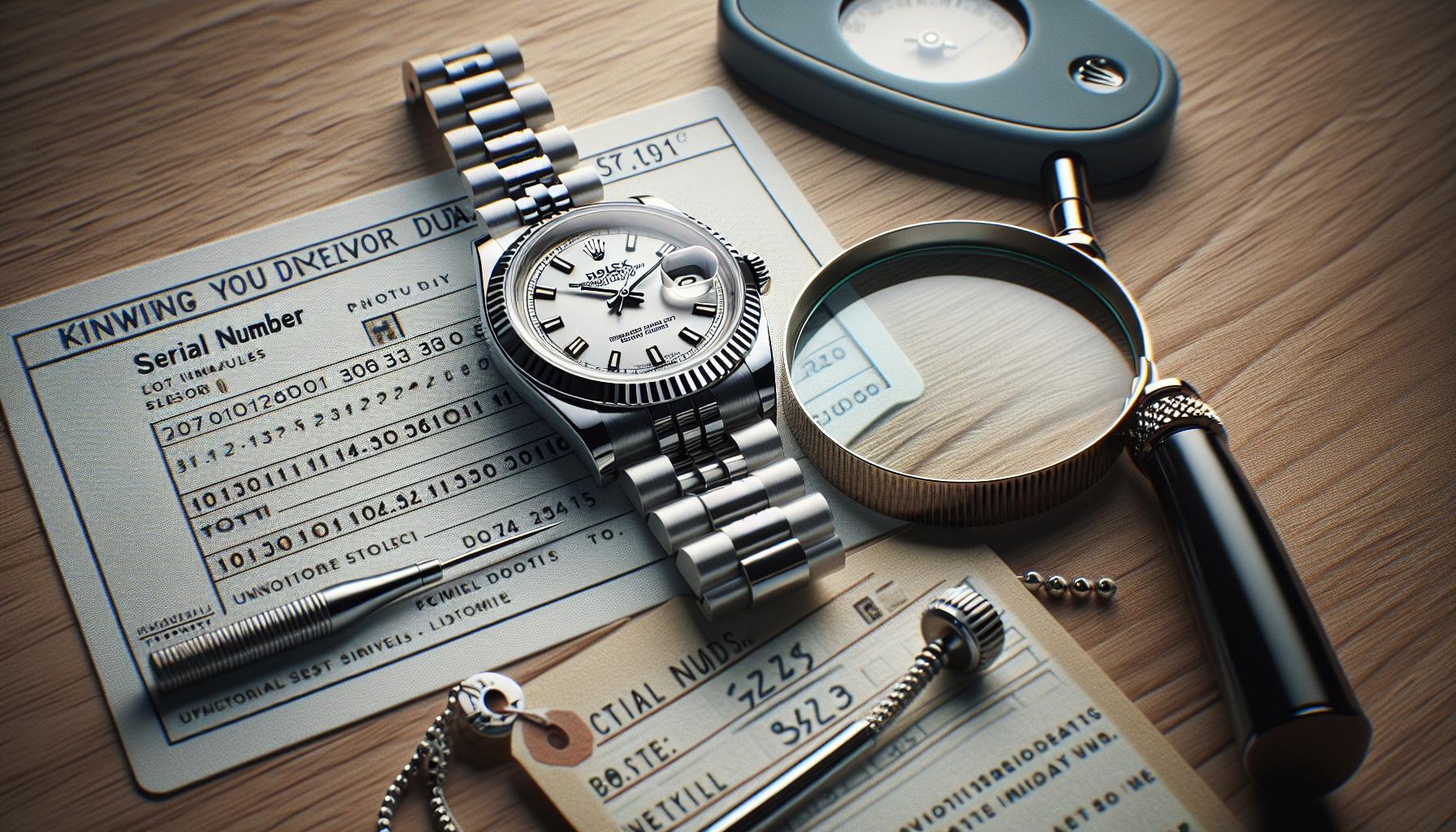
Why Knowing Your Rolex Datejust Serial Number Matters
A Rolex Datejust’s serial number isn’t just a string of digits-it’s a gateway to a deeper understanding of your watch’s identity and history. Beyond serving as a unique fingerprint, this number unlocks data about the production year, helping you place your Datejust in the broader timeline of Rolex’s evolution. Knowing this detail can enhance your appreciation for the watch’s craftsmanship, revealing whether your automatic caliber hails from a specific innovative era or represents a rare transitional model that collectors admire.
Understanding your Datejust’s serial number also plays a crucial role when verifying authenticity. Rolex watches are frequently mimicked, and counterfeiters often overlook or poorly replicate the exact serial number placement and engraving style. Having the serial number at hand allows you to cross-check it with official Rolex records or trusted databases, offering peace of mind before a purchase or resale.
Making the Most of your Serial Number
- Tracking Service History: Authorized service centers record serial numbers during maintenance. Keeping track of yours can provide a clear service timeline, essential for ensuring ongoing reliability and preserving the movement’s integrity.
- Resale and Value Assessment: The serial number often influences resale values. Watches from certain production periods-perhaps with vintage dials or early-generation calibers-can command premiums. Conversely, modern serial numbers might assure buyers of the latest technical updates like improved movements or anti-magnetic features.
- Insurance and Documentation: When insuring a Datejust, providing the serial number is standard practice. it solidifies ownership claims and aids in recovery should your watch be lost or stolen.
even beyond financial aspects,the serial number connects you to the broader watch community. It allows enthusiasts-whether newcomers or seasoned collectors-to share stories and experiences linked to particular production runs.Imagine spotting a fellow collector with a Datejust bearing a similar serial prefix and exchanging insights about wearability, maintenance quirks, or aesthetic subtleties unique to that era.
In sum, the serial number transforms your Datejust from a mere timekeeper into a documented piece of horological heritage. Embracing this helps cultivate a more informed, confident ownership experience. Whether you’re delving into the mech-tech of Rolex’s in-house calibers or simply savoring the timeless design, the serial number is your key to unlocking the full narrative behind your watch.
authenticity and Serial Numbers: Avoiding Rolex Fakes
Rolex watches, especially iconic pieces like the Datejust, have become prime targets for counterfeiters. What sets a genuine Rolex apart isn’t just the impeccable finish or the in-house automatic movement; one of the most telling indicators is its serial number – a detail that counterfeiters often struggle to replicate accurately. Unlike generic fake marks, Rolex serial numbers have precise placement, depth, and engraving style that collectors and enthusiasts rely on to confirm authenticity.
The serial number on a Datejust is typically found engraved between the lugs at the 6 o’clock position of the case, hidden behind the bracelet. This location is deliberate – discreet yet accessible to informed owners and watchmakers. Fakes often get this wrong, either by placing the number in the wrong spot or using shallow, uneven engraving that feels off to the touch. Authentic Rolex engravings are crisp, clear, and have consistent depth, revealing the meticulous craftsmanship behind even the smallest markings[[[[[1]](https://watchlimit.com/watch-education/rolex-serial-numbers-lookup-year-and-guide/?srsltid=AfmBOoq3luxX3oE8bRt-KHKfaqDVE2RoHZRyJLCjCUU5KA0X1b4IEKkz).
Beyond positioning and engraving quality, the serial number itself tells a story – it corresponds to a production year, and this can be cross-referenced through trusted databases and official Rolex records. An inconsistency here can be a red flag; for example, a serial number indicating a 2005 Datejust, paired with dial styles or bracelet types introduced a decade later, suggests something’s amiss. Similarly, the first few digits may align with specific rolex series information, such as the Datejust’s case material or bezel type[[[[[2]](https://huntingtonwatch.com/pages/rolex-serial-numbers?srsltid=AfmBOorSIPz3KZLViwY6UEz0a7FB1b9srWRApmIkfQJrUM4_W8fQdf9M).
Practical Steps to Verify Your Serial Number and Avoid Fakes
- Check the engraving quality: Use a loupe or magnifying glass to examine the serial number. Look for sharp, even edges and a consistent font style. Fakes often have blurred or shallow engravings.
- Cross-reference production date: Match the serial number to established production year charts widely available online. Make sure the date and style of your Datejust align logically.
- Examine placement carefully: Serial numbers belong in precise spots – commonly between the lugs at 6 o’clock.If it’s anywhere else, treat with suspicion.
- Consult reliable sources: Use trusted databases or professional Rolex service centers for verification. Avoid unofficial third-party sellers without clear records.
- Beware of fake serial numbers: Some replicas duplicate valid serial numbers used by real watches, so serial alone isn’t a guarantee. It’s one piece of the authenticity puzzle.
Many seasoned collectors share stories of spotting smart fakes by combining serial number checks with other hallmarks of Rolex finery: the weight, the smooth movement of the “Cyclops” date magnifier, the subtle embossing on the inside of the sapphire crystal, or the engraved Rolex crown at 6 o’clock on newer models. These micro-details, alongside the serial number, weave together a tight authenticity net.
Ultimately, knowing your Rolex Datejust’s serial number isn’t merely an exercise in curiosity. It’s a key defense against counterfeit risks, empowering you with knowledge to differentiate genuine artistry from clever imitation. Approaching your Datejust with this understanding transforms a simple reference number into a trusted ally, reinforcing why this watch is celebrated not just for its design, but also for its legacy of precision engineering and meticulous craftsmanship[[[[[3]](https://www.bobswatches.com/rolex-serial-numbers?srsltid=AfmBOorqXYgTGGYsRi8orW-rP-Y3YNtKil6BQo9QshshErNTMH5YwqXh).
Using Your Serial number to track Service History and Value
Rolex watches,including the Datejust,are not just timeless pieces of craftsmanship-they are living histories on your wrist. Your watch’s serial number serves as a gateway to uncovering its unique service history and value trajectory, providing crucial context beyond what meets the eye. Whether you’ve inherited a vintage Datejust or are keeping your modern automatic ticking in peak condition, tapping into this information can significantly enhance your ownership experience.
By referencing your rolex Datejust’s serial number, authorized Rolex service centers can track detailed records of any maintenance or repairs performed. This is invaluable as regular servicing-generally recommended every 5 to 10 years-is not only about preserving functionality but also about safeguarding the watch’s accuracy, water resistance, and resale value. Knowing exactly when and what work was done helps you confirm the authenticity of service claims and spot potentially unauthorized work. For example, a well-documented history showing routine servicing and genuine parts replacement can reassure prospective buyers and increase your watch’s market desirability.Beyond service records, the serial number ties directly into the Datejust’s provenance and value. Rolex production dates linked with serial numbers allow collectors to pinpoint the model’s manufacturing year, which affects rarity and market demand considerably. As a notable example, an early 1960s Datejust with an original dial and demonstrable Rolex service history typically commands a premium in auctions and resale markets. Conversely, a serial number revealing a later production date might indicate a model with more standardized features but easier maintenance, which appeals to everyday enthusiasts who prioritize wearability and price point over rarity.
Maximizing Your Serial Number’s Benefits
- Request official service documents: When sending your Datejust to Rolex or an authorized dealer, always ask for a detailed service report tied to your serial number. This ensures accountability and keeps a verifiable history trail.
- Maintain a personal logbook: Even if your watch has been serviced through independent watchmakers,recording dates,work performed,and confirming part authenticity assists future owners and preserves value.
- Understand value fluctuations: Use your serial number to compare your Datejust to recent sales of similar production years online or at auction houses. This real-time market insight keeps expectations grounded and offers negotiation leverage.
- Authenticate parts and provenance: Some Rolex models have slight variations year-over-year. Cross-referencing your serial number with known specifications (dial designs, bezel types, bracelet codes) can identify mismatched components that might affect value.
Connecting the dots between your Datejust’s serial number, servicing records, and market value transforms a numerical engraving into a dynamic asset of knowledge. This empowers collectors and everyday wearers alike to make informed decisions, ensuring their Rolex remains a mechanical joy and a sound investment over time. Remember, a Datejust isn’t just a watch-it’s a legacy you steward, one serial number at a time.
Common Serial Number Questions from Rolex Collectors
Peeling back the layers of your Rolex Datejust’s serial number reveals more than just a string of digits-it’s a key to the watch’s identity,heritage,and authenticity.One of the most common points of curiosity among collectors is precisely where to locate this serial number, especially since it can vary depending on the model year and production run. Before the early 2000s, Rolex serial numbers were traditionally etched between the lugs at the 6 o’clock side of the case, requiring you to remove the bracelet to see it clearly. Post-2005 models introduced a shift with serial numbers often appearing on the inner bezel-also known as the rehaut-a detail that can be viewed from the dial side without needing specialized tools. This shift aimed to make authentication easier and reduce tampering risks.
Collectors frequently ask, “How can I safely view the serial number without damaging my watch or its seals?” Handling a finely crafted Rolex demands care. Removing the bracelet is professional-level work best left to authorized service centers or skilled watchmakers to avoid scratching or compromising water resistance. For watches with serial numbers on the inner bezel,simply tilting the watch under good light often suffices. Avoid using aggressive tools or excessive force; a magnifying loupe and a calm hand can make a big difference. If in doubt, it’s always worth seeking expert assistance-better safe than sorry when dealing with a valuable timepiece.
Another recurring question is about accuracy and authenticity: “Can the serial number confirm whether my Datejust is genuine or a fake?” While a serial number is a critical piece of the authenticity puzzle, it’s not the sole factor.Serial numbers follow specific patterns tied to production years-vintage datejust models will have different numerical sequences or formats than contemporary releases.Comparing your serial number against known Rolex serial number charts can promptly flag inconsistencies. However, professional authentication involves cross-checking serials alongside movement caliber, case engravings, dial fonts, and even the bracelet reference. Smart collectors combine the serial number lookup with thorough physical examination or trusted appraisals to avoid the costly mistake of acquiring counterfeit watches.
enthusiasts frequently enough wonder how the serial number relates to the watch’s value and servicing history. Beyond dating and authenticity, the serial number acts like the watch’s fingerprint in Rolex’s database-authorized service centers log repairs and maintenance tied to these digits.Awareness of this history can reveal if the watch has been regularly maintained, parts replaced, or if it suffered any major issues.This transparency supports value retention and can enhance resale confidence. Some seasoned collectors actively request service records linked to the serial number whenever buying pre-owned Datejusts, turning this insight into a powerful negotiating advantage.
Quick Tips for Rolex serial Number Insights
- Location check: Vintage Datejust serials are between lugs at 6 o’clock; post-2005 models likely on the inner bezel (rehaut).
- Viewing safely: Use a magnifying loupe and good light; avoid forcing bracelet removal unless performed by a pro.
- authenticity tip: Cross-reference serial number patterns with online charts to spot anomalies or fakes.
- Value and service: Ask for linked service records during purchases for a verified maintenance history.
Sometimes, the simplest questions open doors to a deeper appreciation of the craftsmanship and legacy embodied in every Rolex Datejust. Whether you’re new to collecting or a seasoned enthusiast, understanding the nuances of serial numbers elevates your experience from casual ownership to informed stewardship of horological heritage.
Frequently Asked Questions
Q: How can I find the Rolex Datejust serial number without removing the bracelet?
A: The serial number on a Rolex Datejust is typically engraved between the lugs at the 6 o’clock position, which often requires bracelet removal to view. However, some newer models feature the serial number laser-etched on the inner bezel (rehaut), visible without removing the bracelet. Check this area first for easy access and avoid potential scratches. For more safety tips, see the *Tools and Tips for Safely Viewing Your Serial Number* section.
Q: Why does the serial number location differ between older and newer Rolex Datejust models?
A: rolex Datejust serial number placement evolved for security and design improvements. Vintage models show the serial number between the lugs at 6 o’clock, hidden beneath the bracelet, while modern versions (post-2005) moved the engraving inside the rehaut for better authenticity control and ease of viewing. Understanding these differences aids in accurate dating and verification. Learn more under *Serial Number Placement Differences by Production Year*.
Q: What tools are recommended to safely view the Rolex Datejust serial number?
A: To safely inspect the serial number, use a microfiber cloth, a spring bar tool for gentle bracelet removal, and a loupe or magnifying glass.Avoid harsh lighting to prevent glare. These tools help protect your Datejust’s finish while allowing clear visibility of the serial engraving. Refer to *Tools and Tips for Safely Viewing Your Serial Number* for detailed guidance.
Q: Can scratched or worn serial numbers on a Rolex Datejust still confirm authenticity?
A: Yes, even if a Rolex Datejust’s serial number is scratched or faded, authenticity can often be confirmed through professional inspection, examining other hallmarks and movement details. Regular servicing documents and Rolex certificates linked to the serial number also help verify genuineness.for more on authenticity checks, explore *Authenticity and Serial Numbers: Avoiding Rolex Fakes*.
Q: How does the serial number on a Rolex Datejust help in tracking its service history?
A: The serial number is crucial for tracking your rolex Datejust’s official service records. Authorized Rolex service centers log this number with each maintenance, making it easy to access the watch’s care history and retain its resale value. Keeping a record of your serial number ensures seamless service tracking. See *Using Your serial Number to Track Service History and Value* for details.
Q: Are there differences in serial number engraving visibility on steel vs. precious metal Rolex Datejust models?
A: Yes, the serial number’s contrast can vary; steel Datejusts frequently enough have deeper, more visible engravings, while precious metal models like gold or platinum may feature finer, subtler engravings due to softer materials. Using proper lighting or magnification enhances readability. Understanding these nuances assists collectors in accurate identification.
Q: What steps can I take if I cannot locate the serial number on my Rolex Datejust?
A: if the serial number isn’t visible, first ensure the bracelet is removed carefully to check between the lugs at 6 o’clock. If still unseen, inspect the inner rehaut for newer models. If difficulties persist, consult a certified Rolex watchmaker or authorized dealer for expert assistance. For safe viewing methods, refer to *Tools and Tips for Safely Viewing Your Serial Number*.
Q: How can knowing the serial number location improve my Rolex Datejust buying experience?
A: Understanding where to find the Rolex Datejust serial number empowers you to verify authenticity instantly, estimate production year, and assess value confidently during purchase. This knowledge guards against counterfeits and helps negotiate price based on verified specs. Learn more about decoding serials in *Reading and Decoding Your Rolex Datejust Serial Number* to enhance your collector journey.
—
For deeper insights,consider reviewing the full guide on *Where is the Serial Number on a Rolex Datejust?* for technical details and expert tips. Feel free to explore related articles on Rolex model comparisons and care advice to further elevate your horology expertise.
To Conclude
Locating the serial number on your Rolex Datejust is essential not only for verifying authenticity but also for understanding the watch’s production era and valuation-key factors whether you’re a collector or preparing for resale. With its reliable automatic movement and timeless design, the Datejust remains a benchmark of Rolex’s craftsmanship and in-house caliber innovation. if you want to dive deeper into Rolex identification or explore comparisons with iconic models like the Submariner, check out our detailed guides on rolex Serial Number History and Rolex Datejust vs. Submariner: Key Differences.
Ready to authenticate your timepiece or curious about maintenance tips to preserve value? Don’t hesitate to explore our expert resources or sign up for our newsletter to receive updates on watch collecting, valuations, and horology news. Have questions or stories about your Datejust? Share your experience below and join a community passionate about watches that blend mechanical artistry with approachable enthusiasm. Keep your Rolex knowledge sharp and your collection growing-after all, every serial number tells a story worth uncovering.


