Iwc Vs Rolex
IWC vs Rolex: The Ultimate Luxury Watch Brand Comparison
When venturing into the world of high-end luxury watchmaking, two names consistently emerge as pillars of prestige, history, and engineering excellence: Rolex and IWC Schaffhausen. Both brands command immense respect from collectors and casual enthusiasts alike, yet they approach horology from vastly different philosophies. Rolex is the undisputed king of brand recognition, status, and robust reliability. IWC, on the other hand, is the quintessential “watchmaker’s watch,” celebrated for its complex complications, aviation heritage, and understated elegance. Choosing between IWC vs Rolex is not just about telling time; it is about choosing a statement of personal style and horological values. This comprehensive comparison will break down the key differences in history, design, movements, and investment value to help you make an informed decision.
Contents
Brand History and Heritage
Understanding the DNA of a watch brand begins with its origins.
Rolex: Founded in London in 1905 by Hans Wilsdorf (and later moved to Geneva, Switzerland), Rolex was built on a foundation of reliability and innovation. Wilsdorf was obsessed with precision and durability. Rolex is responsible for several pivotal inventions in watchmaking, including the first waterproof wristwatch case (the Oyster case in 1926) and the first self-winding mechanism with a Perpetual rotor (1931). Rolex has positioned itself as the watch of achievement, worn by explorers climbing Everest, diving the Mariana Trench, and breaking land speed records.
IWC Schaffhausen: The International Watch Company has a unique origin story. It was founded in 1868 by an American watchmaker, Florentine Ariosto Jones, in Schaffhausen, Switzerland. Jones aimed to combine advanced American manufacturing technologies with skilled Swiss craftsmanship. IWC has a rich history of creating highly complicated watches and purpose-built tool watches, particularly in the realm of aviation (the legendary Pilot’s Watches) and anti-magnetic engineering (the Ingenieur).
Design Philosophy and Aesthetics
The visual language of Rolex and IWC appeals to very different tastes.
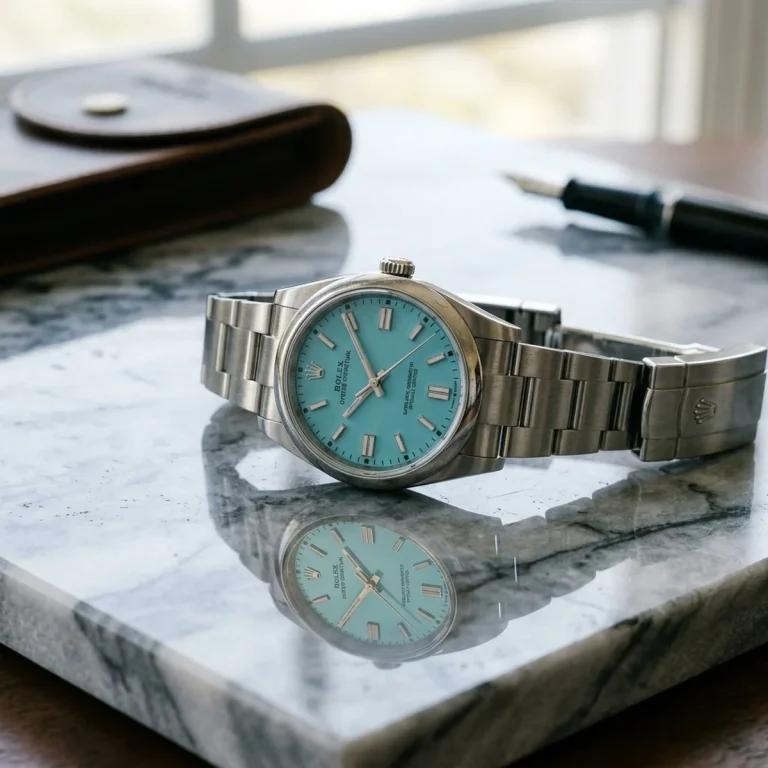
Rolex: Evolutionary and Iconic. Rolex design is famously conservative. They do not follow trends; they set them, and then they rarely deviate. A Rolex Submariner produced today is instantly recognizable as the descendant of the 1953 original. Rolex designs are characterized by their Oyster cases, Cyclops date magnifiers, fluted bezels, and versatile, sporty elegance. They are designed to be “one-watch collections”—robust enough for the beach, refined enough for the boardroom. The aesthetic is universally recognized and undeniably tied to luxury status.
IWC: Instrumental and Complicated. IWC’s design language is heavily rooted in instrumentation. Their Pilot’s Watches feature massive, highly legible dials with bold Arabic numerals and oversized crowns designed to be operated while wearing flight gloves. Their Portugieser line, conversely, offers expansive, elegant dials that house complex chronographs and perpetual calendars. IWC is not afraid of size; many of their iconic watches (like the Big Pilot) are 43mm or larger, making a bold, masculine statement. The IWC aesthetic is less about flashy status and more about mechanical prowess and utilitarian beauty.
Movements and Horological Engineering
Both brands produce exceptional movements, but their focus differs.
Rolex: The Pinnacle of Mass-Produced Precision. Rolex produces its movements entirely in-house. They are not known for high complications (like tourbillons or minute repeaters). Instead, Rolex focuses on absolute reliability, durability, and precision. Their modern movements feature Parachrom hairsprings (anti-magnetic and shock-resistant) and boast a Superlative Chronometer certification, guaranteeing an accuracy of -2/+2 seconds per day—tighter than industry standards. A Rolex movement is a tank; it is designed to run flawlessly for a lifetime with minimal maintenance.
IWC: The Master of Complications. While IWC has historically utilized modified base movements from ETA and Valjoux for their entry-level watches, they are highly respected for their in-house calibers and grand complications. IWC is famous for Kurt Klaus’s legendary perpetual calendar module, which is mechanically programmed until the year 2499 and is astonishingly simple to adjust via the single crown. If you are looking for chronographs, annual calendars, perpetual calendars, or complex tourbillons, IWC offers horological artistry that Rolex simply does not produce.
Iconic Models: Head-to-Head
Comparing the flagship models gives a clear picture of each brand’s identity.
- The Dive Watches: Rolex Submariner vs. IWC Aquatimer. The Submariner is the quintessential dive watch, iconic and infinitely versatile. The Aquatimer is more of a niche, professional diving tool, featuring innovative internal/external rotating bezels and a chunky, modern aesthetic.
- The Aviation Watches: Rolex GMT-Master II vs. IWC Pilot’s Watch (Mark Series/Big Pilot). The GMT-Master II is a jet-setter’s luxury travel watch, famous for its two-tone ceramic bezels. IWC’s Pilot’s Watches are true aviation instruments, prioritizing massive legibility, anti-magnetic soft-iron inner cases, and a rugged military heritage.
- The Dress/Everyday Watches: Rolex Datejust vs. IWC Portugieser. The Datejust is the ultimate versatile everyday watch, available in countless configurations. The Portugieser is a masterclass in elegant, expansive dial design, often housing sophisticated chronograph movements.
Resale Value and Investment
This is arguably where the two brands differ the most.
Rolex: Unmatched Value Retention. Rolex is unique in the watch world regarding supply and demand. Currently, it is nearly impossible to buy a stainless steel Rolex sports model at retail price without a long purchase history. Consequently, Rolex watches almost always hold their value, and many models immediately trade on the secondary market for significantly more than their retail price. A Rolex is often considered a safe financial asset.
IWC: The True Enthusiast’s Market. Like the vast majority of luxury watch brands, IWC watches generally depreciate from their retail price the moment they are purchased. While limited editions and highly complicated pieces may hold value better, a standard IWC is purchased out of love for the watchmaking, not as a financial investment. However, this means you can often find incredible deals on pre-owned IWC watches on the secondary market.
Conclusion: Which Should You Choose?
The choice between IWC and Rolex comes down to what you value most in a luxury timepiece.
Choose Rolex if: You want the ultimate status symbol, you prioritize extreme durability and reliability, you want a versatile watch that goes with anything, and you are concerned with strong resale value and investment potential.
Choose IWC if: You are fascinated by mechanical complications, you prefer an understated “stealth wealth” approach, you appreciate rich aviation or nautical heritage, you love large, highly legible dials, and you want to wear a watch recognized primarily by other true watch enthusiasts.
Frequently Asked Questions (FAQs)
Is IWC considered a luxury brand on par with Rolex?
Yes, IWC is firmly established in the upper echelon of luxury Swiss watchmaking. While Rolex has higher brand recognition globally, horology enthusiasts often view IWC’s complicated movements and finishing as highly prestigious, sometimes ranking their high-complication pieces above standard Rolex offerings.
Does IWC make their own movements?
IWC uses a mix. Historically, they heavily modified ETA and Valjoux ebauches. Today, they produce an increasing number of impressive in-house calibers (like the 52000, 89000, and 69000 families) for their mid-to-high-tier watches, while still utilizing some third-party movements for entry-level models.
Why is Rolex so much harder to buy than IWC?
Rolex restricts supply to maintain brand exclusivity and desirability, and global demand far outpaces their production capacity (approximately 1 million watches a year). IWC operates with a different distribution model, making most of their catalog readily available for purchase at authorized dealers.
Which is better for a small wrist, Rolex or IWC?
Rolex generally offers a wider variety of sizes suitable for smaller wrists, including 36mm Datejusts and Explorers. IWC is famous for large, oversized watches (often 41mm to 46mm), though they have recently introduced smaller 36mm and 39mm Pilot and Portofino models to cater to a broader audience.
Get our latest guides, news, and insights highlighted in your Google Search & AI Overviews.