Tissot Powermatic 80 Regulate Timing
Tissot Powermatic 80 Regulate Timing: A Comprehensive Guide to Accuracy and Adjustment
The Tissot Powermatic 80 movement has revolutionized the entry-level Swiss luxury watch market. By offering an impressive 80-hour power reserve, robust reliability, and accessibility in popular models like the Tissot PRX, Seastar, and Le Locle, it has become a staple for both new collectors and seasoned horologists. However, a common topic of discussion among owners revolves around accuracy and regulation.
Unlike traditional mechanical movements with a conventional regulator index, the Powermatic 80 utilizes a free-sprung balance architecture. This makes regulating the timing of a Tissot Powermatic 80 significantly different—and more complex—than adjusting a standard ETA 2824-2 or Seiko NH35. In this comprehensive guide, we will explore how the Powermatic 80 achieves its accuracy, what the acceptable tolerances are, and the realities of regulating its timing.
Contents
Understanding the Powermatic 80 Movement
To understand how to regulate the Powermatic 80, we must first understand what it is. The Powermatic 80 (also known internally as the ETA C07.111 series) is an evolution of the legendary ETA 2824-2.
To achieve the massive 80-hour power reserve, the Swatch Group (ETA’s parent company) made several crucial modifications:
- Reduced Beat Rate: The frequency was lowered from 28,800 vibrations per hour (vph) / 4Hz down to 21,600 vph / 3Hz. This consumes less energy.
- Improved Mainspring: A thinner, longer mainspring was utilized in the barrel.
- Friction Reduction: The escapement was optimized using high-tech materials (some versions use synthetic components or silicon hairsprings) to reduce friction.
- Free-Sprung Balance: Crucially for regulation, the traditional regulator pin (which adjusts the active length of the hairspring) was removed. Instead, a free-sprung balance wheel is used, regulated entirely by mass adjustment.
Acceptable Accuracy Tolerances for the Powermatic 80
Before assuming your Tissot needs regulation, it is vital to know the manufacturer’s specified tolerances. The Powermatic 80 comes in several different grades, each with different accuracy standards.
1. Standard Grade Powermatic 80
Found in many base models (like the standard PRX), this version is adjusted by laser at the factory. Tissot generally states an acceptable tolerance of +/- 10 to 15 seconds per day. If your watch is running +8 seconds a day, it is functioning perfectly within spec.
2. COSC Chronometer Grade
Found in models explicitly labeled “Chronometer” on the dial (such as the Tissot Gentleman Powermatic 80 Silicium). These movements have been independently tested by the Contrôle Officiel Suisse des Chronomètres and are guaranteed to run between -4 and +6 seconds per day across various positions and temperatures.
How the Powermatic 80 is Regulated (The Free-Sprung Balance)
If you open the case back of a watch with a standard ETA 2824 or a Seiko movement, you will see a small lever (the regulator index) with a “+” and “-” sign. Nudging this lever speeds up or slows down the watch. This is an easy task for almost any amateur watchmaker.
The Powermatic 80 does not have this lever.
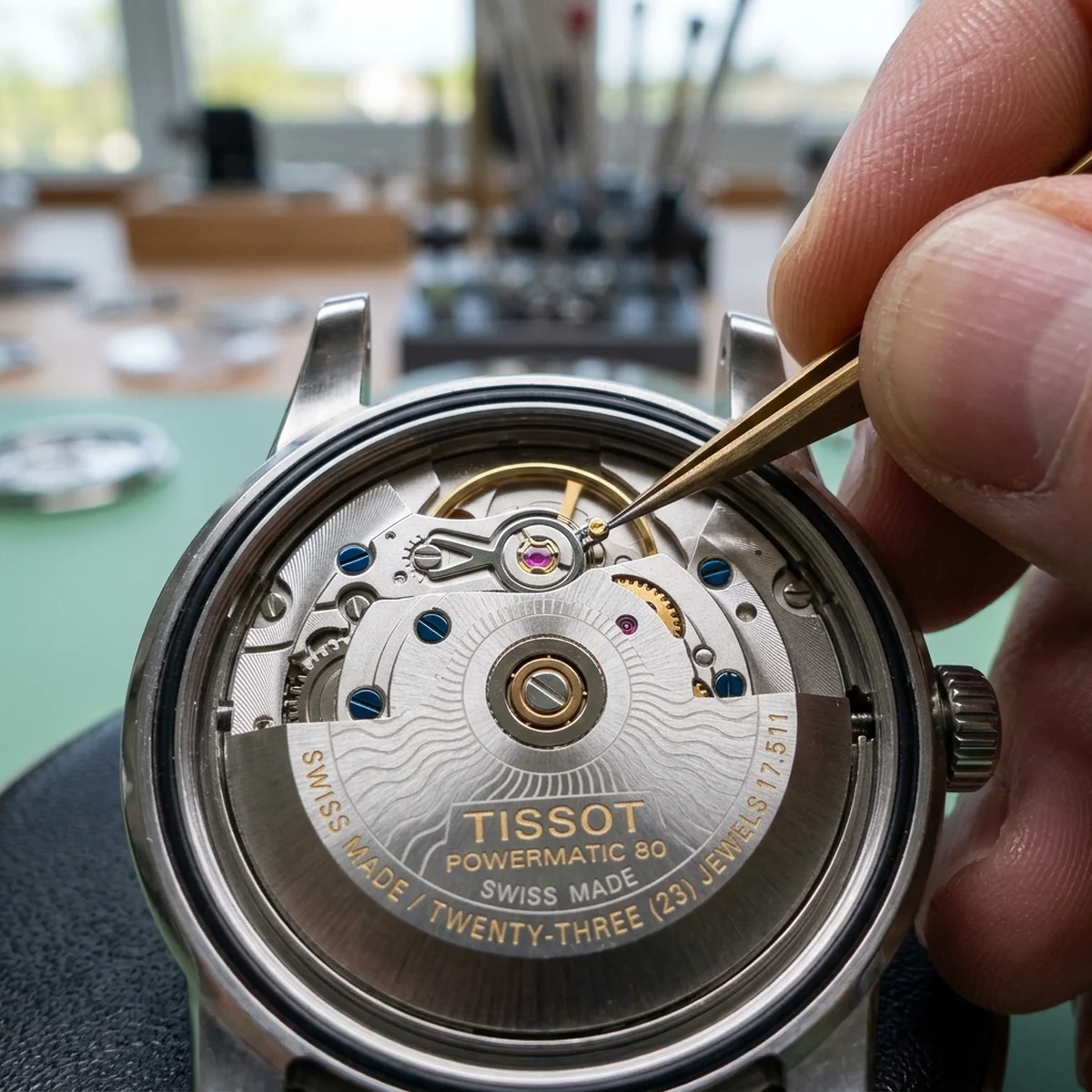
Instead, it uses a high-tech “free-sprung” balance wheel. This is a technology usually reserved for high-end luxury brands like Rolex, Patek Philippe, and Omega. The hairspring length is fixed. To adjust the timing, one must alter the inertia of the balance wheel itself.
On the balance wheel of the Powermatic 80, there are two small weights (often eccentric screws or asymmetric mass blocks). Turning these tiny weights alters the balance wheel’s moment of inertia, much like a figure skater pulling their arms in to spin faster or extending them to slow down.
Can You Regulate a Powermatic 80 at Home?
The short answer is no. It is highly discouraged to attempt regulating a Powermatic 80 yourself.
Here is why DIY regulation is incredibly risky on this movement:
- Specialized Tools Required: You cannot use a standard screwdriver. The adjustment weights on the balance wheel require proprietary Swatch Group tools that fit perfectly into the eccentric weights to turn them without slipping.
- Microscopic Adjustments: The adjustments required are microscopic. Turning the weight even a fraction of a millimeter too much can drastically alter the timing.
- Risk of Damage: The balance wheel and hairspring are the most delicate parts of the watch. Slipping with a tool can instantly destroy the hairspring or snap a balance staff, turning a simple regulation into a $250+ repair bill.
- Laser Calibration: Standard Powermatic 80 movements are factory-regulated by a highly precise laser system that adjusts the weights. Human hands cannot easily replicate this precision without professional training and a timegrapher.
What to Do If Your Tissot is Running Fast or Slow
If your watch is running outside of the acceptable factory tolerances (e.g., gaining 30 seconds a day or losing 20 seconds a day), follow these steps:
1. Check for Magnetization
By far, the most common reason for a modern mechanical watch to suddenly run very fast (gaining minutes a day) is magnetization. Smartphones, laptops, and speakers emit magnetic fields that can cause the coils of the hairspring to stick together, artificially shortening the spring and making the watch run fast.
Note: If your Powermatic 80 features the “Silicium” (silicon) hairspring or the Nivachron hairspring, it is highly anti-magnetic, and this is unlikely to be the issue.
The Fix: You can buy a cheap watch demagnetizer online for $15, or take it to any local jeweler who can demagnetize it in 10 seconds.
2. Understand Positional Variance (Resting Positions)
Gravity affects the balance wheel. A watch will run slightly differently depending on how it rests overnight. You can use this to self-regulate minor deviations:
- To slow the watch down: Leave it resting vertically overnight, either crown up or crown down (this increases friction on the balance staff pivots).
- To speed the watch up: Leave it resting flat overnight, dial up (this minimizes friction).
Experiment with resting positions before seeking professional regulation.
3. Professional Servicing
If the watch is truly inaccurate and demagnetizing doesn’t help, you must take it to a professional. Because of the proprietary tools required for the free-sprung balance, it is highly recommended to send the watch directly to an authorized Swatch Group Service Center or take it back to your Authorized Dealer. Independent watchmakers may not have the specific tools or access to spare parts needed for the C07.111 caliber.
Conclusion
The Tissot Powermatic 80 is an engineering marvel that brings high-end, free-sprung balance technology to the masses, resulting in excellent power reserve and long-term stability. However, the trade-off for this advanced architecture is that it cannot be easily regulated by the end-user.
If your watch is within the +/- 15 seconds per day tolerance, enjoy it as the mechanical marvel it is. If it strays beyond that, rely on positional resting tricks, check for magnetism, and, when in doubt, trust it only to certified Swatch Group professionals.
Frequently Asked Questions (FAQ)
Why does my Powermatic 80 not have a regulator lever?
The Powermatic 80 was designed with a free-sprung balance wheel to improve long-term stability, shock resistance, and to allow for highly precise, automated factory regulation via laser. This design eliminates the need for a traditional regulator index.
Can a local independent watchmaker regulate my Tissot PRX?
It depends. While any competent watchmaker understands the theory of a free-sprung balance, they may lack the proprietary Swatch Group tool required to physically turn the micro-weights on the Powermatic 80’s balance wheel without damaging it. It is usually safer to use an authorized service center.
Is +12 seconds a day bad for a mechanical watch?
For a standard grade Powermatic 80, +12 seconds a day is perfectly normal and well within the factory specifications. Only COSC-certified chronometers are guaranteed to perform strictly within -4/+6 seconds a day.
Does the Powermatic 80 movement contain plastic parts?
Some versions of the Powermatic 80 (specifically the caliber C07.111 used in base models) utilize a synthetic (often referred to as plastic or composite) escapement to reduce friction and eliminate the need for lubrication in that area. Higher-tier versions (like the C07.811) use traditional metal escapements and silicon hairsprings. Neither is inherently “bad,” but purists often prefer the metal escapements.
Get our latest guides, news, and insights highlighted in your Google Search & AI Overviews.